Latter Day Saint Message on Divorce and Eternal Family
Ordinance (Latter Mean solar day Saints)
Last updated 
Artist's depiction of a Latter Day Saint baptism including the all-white article of clothing, circa 1850.
In the Latter Day Saint motion, the term ordinance is used to refer to sacred rites and ceremonies that have spiritual and symbolic meanings and act as a means of conveying divine grace. Ordinances are physical acts which signify or symbolize an underlying spiritual human action; for some ordinances, the spiritual act is the finalization of a covenant between the ordinance recipient and God.
- Types of ordinances
- Saving ordinances
- Non-saving ordinances
- Meet also
- Notes
- References
Ordinances are unremarkably performed past the authority of the LDS priesthood and in the name of Jesus Christ. The use of the term "ordinance" in LDS parlance is distinct from the apply of the term in other branches of Christian tradition, where "ordinance (Christian)" is frequently used to imply that the deed is merely symbolic and does non convey grace. LDS use of the term "ordinance" carries the same significant as the term "sacrament" as used by other Christian denominations. [1] Customs of Christ-derived denominations of the Latter Twenty-four hours Saint movement also tend to refer to "sacraments" rather than "ordinances".
Some ordinances, such as baptism, confirmation and the sacrament of the Lord'due south Supper, are similar to those proficient by other Christian denominations. Other Latter Solar day Saint ordinances are unique and usually performed inside a Latter Day Saint temple. These ordinances include the endowment and sealings.
Types of ordinances
Saving ordinances
.png)
Saving ordinances are those ordinances that are a requirement for exaltation. Most Latter 24-hour interval Saints denominations see saving ordinances as necessary, merely not sufficient, requirements for exaltation. For example, baptism is believed to exist required for exaltation, but simply having been baptized does not guarantee such a consequence. The baptized person is expected to become on to exist obedient to God's commandments and to receive other saving ordinances.
The post-obit are examples of saving ordinances in near sects of the Latter Twenty-four hours Saint motion:
- Baptism : Performed by immersion at age eight or older. Baptism is seen as symbolic both of Jesus' death, burial and resurrection [ii] and is also symbolic of the baptized individual putting off of the natural or sinful human being and condign spiritually reborn every bit a disciple of Jesus.
- Confirmation and reception of the Souvenir of the Holy Ghost : Performed past laying easily on the caput of a newly baptized member. Through confirmation, the initiate becomes an official fellow member of the church and receives the "gift of the Holy Ghost". [3]
- Ordination to the Priesthood : In the Latter 24-hour interval Saint movement, the priesthood is the ability and authority of God given to man, including the authority to perform ordinances and to human action equally a leader in the church. Latter Solar day Saint theology has recognized at least iii orders of priesthood: (1)the Aaronic priesthood, (2)the Melchizedek priesthood; and (3)the Patriarchal priesthood. Although these are dissimilar orders, they are all subsumed under the priesthood held by Jesus Christ, or the Melchizedek priesthood. For most of the history of the Latter Twenty-four hours Saint movement, only men have been ordained to specific offices in the priesthood, and about Latter 24-hour interval Saint denominations still restrict their priesthood to men. However, some exceptions to this policy practise exist, such every bit within the Church of Jesus Christ of Latter Day Saints (Strangite), [4] a church building founded by James J. Strang, and the Customs of Christ, which began ordaining women to all of its priesthood offices in 1984.
Temple ordinances

In some Latter Solar day Saint churches, some boosted saving ordinances are performed in temples. These include the endowment, the washing and anointing, and sealings. Currently, simply LDS Church building-derived and Cutlerite-derived [5] denominations within the Latter Day Saints movement practice all three. Other Latter Day Saint denominations, such as Community of Christ-derived [6] and Hedrickite-derived [seven] denominations do not perform whatever of them. Still other denominations, such Strangite-derived [8] denominations, practise sealings just reject the washing and anointing and the endowment.
- Endowment : Referred to as a souvenir of "power from on loftier" by Joseph Smith, the purpose and meaning of the endowment varied during his lifetime. Subsequently 1842, the endowment usually consists of ii phases: (one) an initiation, and (2) an instructional and testing phase. The initiation consisted of the washing and anointing, culminating in the wear of the patron in a "Garment of the Holy Priesthood". The instructional and testing phase of the endowment consisted of a scripted reenactment of Adam and Eve'south experience in the Garden of Eden. [9] The instruction is punctuated with personal covenants, gestures, and a prayer circle around an chantry. At the terminate of instruction, the initiate'due south knowledge of symbolic gestures and key-words is tested at a "veil", a symbolic final borderland for the initiate to face up the judgement of Jesus, before entering the presence of God in the Celestial Kingdom. [x]
- Marriage and sealing : An ordinance where individuals are married and sealed as husband and married woman as an eternal family. Whatever children the couple may already have are sealed to the family and whatsoever children born into this marriage after sealing are also sealed into that family which will live together forever, if obedient to God'due south commandments. Children that are brought into the family later, though non born into the family such as via adoption, can be sealed to the family unit later on in a sealing anniversary without the need for the marriage portion. This ordinance is particularly performed by the LDS Church [11] : 57 and branches of Mormon fundamentalism.
- Sealing to parents: For children born before a marriage and sealing is performed or who take been adopted into a family, this ordinance seals them into that family every bit if they had been born into a sealed family unit.
Saving ordinances on behalf of the expressionless

According to Latter Mean solar day Saint theology, ordinances can exist performed vicariously (i.e. post mortem) on behalf of whatever person who would want to accept the ordinance merely did non receive it. While, some sects such equally the Hedrickite denominations, have rejected some or all vicariously performed ordinances, other denominations, such as the LDS Church, still perform the saving ordinances on behalf of their deceased ancestors. These are performed vicariously or past "proxy" on behalf of the dead, and church members believe that information technology is up to the deceased to accept or reject the offered ordinance in the spirit globe. Since deceased persons no longer have an earthly beingness, they are unable to directly participate in these "saving" ordinances themselves. The physical functioning of these ordinances by proxy is seen equally fulfillment of the requirement. As with living ordinances, ordinances for the expressionless are seen as necessary just not sufficient. It is believed that the spirits in the spirit world are offered the teachings of the full gospel of Jesus Christ and take the opportunity to have or decline vicarious ordinances done on their behalf. Some LDS Church members refer to the reference by Paul in 1 Corinthians 15:29 regarding baptism for the dead as show that this was a religious practice of aboriginal tradition that has now been restored by the LDS Church building. [12]
Non-saving ordinances
Ordinances which are not a requirement for exaltation are referred to every bit non-saving ordinances. A non-saving ordinance may be performed on behalf of an private many times; in do, nonetheless, some not-saving ordinances are only performed once per individual. While not every denomination performs each of these ordinances, they can be found throughout Latter Day Saint theology.
- Beast sacrifice : The ordinance of animal sacrifice was instituted in the Strangite denominations, [thirteen] primarily as a part of Strangite celebration rituals. Though the chapter on "Sacrifices" in Strang's Volume of the Law of the Lord speaks of them as being offered for sins, the prohibition on such sacrifices contained in 3 Nephi 9:xix–twenty, [14] meant that Strang focused instead on sacrifice as an element of religious festivities, [15] [16] especially the commemoration of the coronation a king. [17] The head of every house, from the king to his lowest subject, was to offer "a heifer, or a lamb, or a dove. Every man a clean beast, or a clean fowl, according to his household." [18]
- Anointing of the Ill/Administration to the Sick and Consecrating oil : A person who is physically ill, emotionally strained, or sick in any other style may asking administration of this blessing or ordinance. The purposes to provide assurance of God's care and business concern and as well of the church's interest in that person. Oftentimes this included the anointing of the head of the person with consecrated oil, necessitating the ordinance of "Consecrating oil".
- Calling : This ordinance requires that a person having responsibility over a unit or an auxiliary of the church prayerfully seek revelation to determine which individual is to fill detail responsibilities inside that organization. If the individual agrees—and many persons wait to receive spiritual confirmation before like-minded—then the individual is "called" to the position.
- Dedication of a church building or a temple: This ordinance is performed afterwards the building is completed or purchased; if a edifice undergoes extensive remodeling, this ordinance may exist performed again.
- Dedication of a grave: This ordinance is performed immediately earlier the body is placed in the grave; it is usually performed only once.
- Dedication of a state or country for the preaching of the gospel: This ordinance is usually performed before or before long after missionaries begin to preach in a particular country; it is usually performed merely once (simply may be performed again if missionaries have not been in a detail state for an extended period of time); it is typically performed past an apostle.

Rigdonite/Bickertonite Pes washing in the Philippines - Foot washing: The ordinance of human foot washing was instituted in the Rigdonite/Bickertonite denominations as a demonstration of personal humility. Members follow the ordinance of as described in Johnthirteen:5 4 times a year, when members greet each other with a "holy kiss", preferably on the cheek, to signify that they are greeting each other in the love of God, in accordance with the description given in the Rex James Version of the New Testament. [19] [twenty] The Rigdonite/Bickertonite denominations believes that this is a very of import ordinance, citing Jesus' statement to Peter: "If I launder thee not, thou hast no part with me." [20]
- Hosanna Shout : An organized ritual of a congregation of shouting hosanna, as a recitation of praise to God, while waving a white handkerchief, and is usually performed every bit a ritual in the dedication of a Temple. Information technology was outset used every bit part in the dedication the Kirtland temple and was office of the Kirtland endowment ceremony.
- Naming and blessing a kid : Typically this ordinance is performed shortly but once after a child'southward birth in fulfillment of the commandment in the Doctrine and Covenants: "Every member of the church building of Christ having children is to bring them unto the elders earlier the church, who are to lay their hands upon them in the name of Jesus Christ, and bless them in his proper name." [21] The purpose of the practice is twofold: to give a baby an official name and to provide an opportunity to give a blessing for the child's spiritual and physical welfare.
- Patriarchal blessing /Evangelist's approval: A blessing or ordinance given normally one time by a patriarch to a church fellow member. Patriarchal blessings are modeled after the blessing given by Jacob to each of his sons prior to his death and are considered a gift of knowledge and force of one's coming challenges and blessings.
- Prayer circle : An antiphonic prayer around an altar, performed as office of the endowment and on other occasions, such among the Churchly United Brethren and the True and Living Church of Jesus Christ of Saints of the Last Days, where prayer circles within temples, endowment houses, and homes are still mutual.
- Priesthood approval (including father's blessings): A prayer for healing, comfort or counsel given by a Melchizedek Priesthood holder, who lays his hands on the head of the person receiving the blessing.
- Rebaptism of faithful members: In tardily 1839, many who were already baptized members of the church, were rebaptised either to show a renewal of their commitment to the movement or as part of a healing ordinance. Some denominations, such every bit the Customs of Christ, never performed this ordinance. While others, like the LDS church historically performed this ordinance, such as during the Mormon Reformation, but no longer exercise.
- Sacrament / Lord'due south Supper : An ordinance in which participants eat bread and drink vino, water, or unfermented grape juice [22] in remembrance of the torso and claret of Jesus Christ. It is similar to the Eucharist in the Catholic Church, or communion in Protestant denominations. Commonly, the sacrament is provided either every Sunday, on the first Sun of each month, as part of the regular meeting, or other boosted special occasions. Strictly speaking, this is a non-saving ordinance because a person could be exalted without ever having participated in the sacrament. However, individuals who have been baptized are expected to regularly participate in the sacrament.
- Setting apart : An ordinance where a person is formally chosen and blessed to acquit out a specific calling or responsibility in the church. One time a person has accustomed the responsibility of property a calling and has been "Sustained" by the members of the church for that position, one or more priesthood holders "set autonomously" the person to serve in that calling, usually accomplish by giving the person a priesthood blessing by the laying on of easily.
- Shaking the grit from the feet : A cursing ordinance in which a priesthood holder leaves a curse instead of a approving, by casting off the grit of their feet "against them as a testimony, and cleansing your feet past the wayside." Information technology was most oft used against those who rejected the teachings of the church, or who failed to provide missionaries, with food, money, or shelter. Since the early-20th century, the practice has been rare.
- Ritual of the police force of adoption : An ordinance practiced mainly between 1846 and 1894 in which priesthood men were sealed in a father–son relationship to other men who were not part of nor even distantly related to their firsthand nuclear family. There is no surviving show that the "police force of adoption" sealing practice was taught by Joseph Smith or his contemporaries prior to Smith'due south death in 1844. Withal, adoptions appeared on the records of the Nauvoo Temple in 1846, and scholars generally presume that the practice was instituted by Brigham Young. [23] Following an accost on eight April 1894 past Wilford Woodruff, the exercise of the law of adoption ceased in the LDS Church. [24] However, some denominations, such as the Restoration Church of Jesus Christ. [25] (commonly referred to equally the "Gay Mormon Church"), proceed to perform the ritual of the law of adoption.
- Second anointing : An ordinance performed for a sealed couple, sealing them up to eternal life, and anointing them equally kings and queens, priests, and priestesses. In the LDS Church it is also called the fulness of the priesthood, and is a rare, but currently skilful ordinance for live participants, [26] [27] [28] and (less commonly) vicariously for deceased individuals, [29] though, it is usually only given in absolute secrecy to a pocket-size number of members after a lifetime of service. [30] The ordinance is likewise still performed by many Mormon fundamentalist groups.
See also
- The Church building of Jesus Christ (Bickertonite)#Ordinances
- Ordinance room
- Reverence (emotion)
Notes
- ↑ "Sacrament - The Encyclopedia of Mormonism". Eom.byu.edu. Archived from the original on 10 October 2018. Retrieved 16 October 2018.
- ↑ "Scriptures: Study Helps: Bible Dictionary". LDS Church building.
Baptism, ¶2
- ↑ Craven, Rulon Yard. (1992), "Confirmation", in Ludlow, Daniel H (ed.), Encyclopedia of Mormonism, New York: Macmillan Publishing, pp.310–311, ISBN 0-02-879602-0, OCLC 24502140
- ↑ Strang, James J. (1856). Book of the Law of the Lord, Existence a Translation from the Egyptian of the Law Given to Moses in Sinai. St. James: Royal Press. pp.199, 227. Archived from the original on 2007-10-xiii.
- ↑ Fletcher, Rupert J. and Daisy Whiting, Alpheus Cutler and the Church of Jesus Christ. Church of Jesus Christ, 1974, pg. 333–337.
- ↑ Elbert A. Smith, Differences That Persist betwixt the RLDS and LDS Churches, (1950), website accessed 2008-06-xi.
- ↑ "Articles of Religion and Practice of the Church of Christ". Archived from the original on 2009-03-31. Retrieved 2009-08-05 .
- ↑ "Women/Marriage". Strangite.org . Retrieved 2007-x-28 .
- ↑ "President Gordon B. Hinckley", Ensign (supp.), Mar. 2008, pp. 2–13.
- ↑ Buerger (1987), pp.44–45.
- ↑ Church Handbook of Instructions 2010.
- ↑ Burton, H. David; Stendahl, Krister (1992). "Baptism for the Dead". In Ludlow, Daniel H (ed.). Encyclopedia of Mormonism. New York: Macmillan Publishing. pp.95–97. ISBN 0-02-879602-0. OCLC 24502140.
- ↑ Book of the Law, pp.106–109.
- ↑ Book of Mormon.
- ↑ Book of the Police force, pp.293–297.
- ↑ "Latter Mean solar day Saints and Brute Cede". Archived from the original on 2002-06-nineteen. Retrieved 2002-06-19 .
- ↑ Book of the Law, p.293.
- ↑ Book of the Law, pp.293–294.
- ↑ Cadman, Due west.; Armbrust, J.; Wright, W. (1897). Faith and Doctrines of The Church of Jesus Christ. West Elizabeth, PA: The Church building of Jesus Christ.
- one 2 Valenti, Jerry (2000). Welcome to The Church building of Jesus Christ. Monongahela, PA: The Church of Jesus Christ.
- ↑ Doctrine and Covenants 20:seventy
- ↑ Bolton, Andrew and Jane Gardner: "The Sacraments: Symbol, Meaning and Discipleship." Independence: Herald House, 2005.
- ↑ Brooks, Juanita (1992) [1961], John Doyle Lee: Zealot, Pioneer Builder, Scapegoat, Logan, Utah: Utah Land University Press, p.73, ISBN 0-87421-162-X, OCLC 42329435
- ↑ Irving 1974 , p. 312
- ↑ Feliz, Antonio A. (1992) [1988], Out of the Bishop's Cupboard (2nded.), San Francisco: Alamo Foursquare Press, ISBN 978-0-9624751-7-7, OCLC 26940235
- ↑ Quinn, D. Michael (1992). "Mormon Women Have Had the Priesthood Since 1843". In Hanks, Maxine (ed.). Women and Authority: Re-emerging Mormon Feminism. Salt Lake Metropolis: Signature Books. p.377. ISBN 1-56085-014-0.
Currently some women have received this 'fullness of the priesthood' with their husbands. In the Salt Lake temple, the 2nd anointing nonetheless occurs in the 'Holy of Holies' room which James Due east. Talmage wrote 'is reserved for the higher ordinances in the Priesthood...' The second anointing for both men and women is singled-out from ordination to church priesthood offices.
- ↑ Buerger (2002), p.66. "In practice today the 2d anointing is actually the beginning of 2 parts comprising the fullness of the priesthood anniversary."
- ↑ Buerger (1983), pp.42–43.
- ↑ Buerger 1983 , pp. 42–43. "Even so, occasional instances of present-day anointings have occurred. Vicarious second anointings are likewise performed, simply are less frequent."}}
- ↑ Kramer, Bradley H. (2014). Keeping the Sacred: Structured Silence in the Enactment of Priesthood Dominance, Gendered Worship, and Sacramental Kinship in Mormonism (PDF) (PhD). University of Michigan. p.33.
The public/open secrecy of temple-work in full general stands in contrast to the bodily and absolute secrecy of ane detail feature of its ritual corpus: the ordinance known variously as the Second Anointing (or 2nd Anointings), 2d endowment, or the Fullness of the Priesthood. The blessings of this ordinance are conferred onto only a very small number of Mormons, usually after the better role of a lifetime of faithful and loyal service. ... These rites are a closed, absolute undercover. Only those Mormons considered most trustworthy past high Church leadership are invited to participate, and they are expressly instructed not to disclose anything about the ordinance, including their own participation in information technology, to anyone, including family unit (only married couples participate in the rite).
Related Research Articles

Mormonism is the religious tradition and theology of the Latter Twenty-four hour period Saint movement of Restorationist Christianity started by Joseph Smith in Western New York in the 1820s and 1830s. Equally a label, Mormonism has been applied to various aspects of the Latter Day Saint movement, although there has been a recent push from The Church of Jesus Christ of Latter-24-hour interval Saints to distance themselves from this label. A historian, Sydney E. Ahlstrom, wrote in 1982, "One cannot even be sure, whether [Mormonism] is a sect, a mystery cult, a new religion, a church building, a people, a nation, or an American subculture; indeed, at different times and places information technology is all of these". However, scholars and theologians within the Latter Solar day Saint movement, including Smith, take often used "Mormonism" to describe the unique teachings and doctrines of the move.
In the Latter Solar day Saint movement, priesthood is the power and potency of God given to man, including the authority to perform ordinances and to act as a leader in the church. A grouping of priesthood holders is referred to as a quorum.
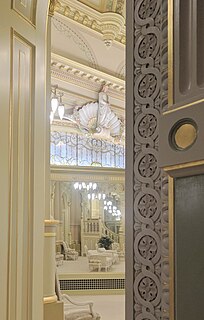
In Mormonism, the endowment is a two part ordinance (anniversary) designed for participants to go kings, queens, priests, and priestesses in the afterlife. Every bit part of the first anniversary, participants take part in a scripted reenactment of the Biblical creation and fall of Adam and Eve. The anniversary includes a symbolic washing and anointing, and receipt of a "new name" which they are not to reveal to others except at a certain office in the anniversary, and the receipt of the temple garment, which Mormons and then are expected to wearable under their clothing day and night throughout their life. Participants are taught symbolic gestures and passwords considered necessary to laissez passer by angels guarding the way to heaven, and are instructed not to reveal them to others. As expert today in The Church building of Jesus Christ of Latter-solar day Saints, the endowment likewise consists of a series of covenants that participants make, such as a covenant of consecration to the LDS Church. All LDS Church members who choose to serve as missionaries or participate in a celestial union in a temple must first complete the first endowment anniversary.

Sealing is an ordinance (ritual) performed in Latter Twenty-four hours Saint temples by a person holding the sealing authorisation. The purpose of this ordinance is to seal familial relationships, making possible the existence of family relationships throughout eternity. Sealings are typically performed as marriages or every bit sealing of children to parents. They were performed prior to the decease of Joseph Smith, and are currently performed in the largest of the faiths that came from the motility, The Church of Jesus Christ of Latter-day Saints. LDS Church teachings place great importance on the specific authority required to perform these sealings. Church doctrine teaches that this authorisation, called the priesthood, corresponds to that given to Saint Peter in Matthew xvi:19.

In the Latter Day Saint motility, the 2d anointing, or 2d endowment, is the pinnacle ordinance of the temple and an extension of the endowment ceremony. Founder Joseph Smith taught that the function of the ordinance was to ensure salvation, guarantee exaltation, and confer godhood. In the ordinance, a participant is anointed as a "priest and king" or a "priestess and queen", and is sealed to the highest degree of salvation bachelor in Mormon theology.
Mormonism, or the Latter Twenty-four hour period Saint motion, teaches that its adherents are either direct descendants of the Business firm of Israel or adopted into information technology. Every bit such, Mormons regard Jews every bit a covenant people of God, and hold them in high esteem. The Church building of Jesus Christ of Latter-day Saints, the largest church in Mormonism, is philo-Semitic in its doctrine.

Washing and anointing is a temple ordinance practiced by The Church of Jesus Christ of Latter-solar day Saints and Mormon fundamentalists as part of the organized religion's endowment ceremony. It is a sacred ordinance for adults, similar to chrismation, ordinarily performed at least a twelvemonth subsequently baptism. The ordinance is performed by the authority of the Melchizedek priesthood by an officiator of the same gender as the participant.
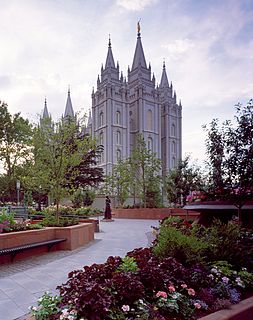
In the Latter Day Saint movement, a temple is a building dedicated to be a business firm of God and is reserved for special forms of worship. A temple differs from a church meetinghouse, which is used for weekly worship services. Temples have been a significant office of the Latter 24-hour interval Saint movement since early on in its inception. Today, temples are operated by several Latter Day Saint denominations. The well-nigh prolific builder of temples of the Latter Day Saint movement is The Church building of Jesus Christ of Latter-day Saints. There are 170 defended temples, 45 under structure, and 50 announced, for a full of 265. Several others within the move have built, or attempted to build, temples. The Community of Christ operates ii temples in the United States, which are open to the public and are used for worship services, performances, and religious education. Other denominations with temples are the Apostolic United Brethren, the Church of Christ, the Fundamentalist Church of Jesus Christ of Latter-Day Saints and the Righteous Branch of the Church building of Jesus Christ of Latter-twenty-four hour period Saints.
Celestial wedlock is a doctrine that spousal relationship can last forever in heaven. This is a unique teaching of The Church of Jesus Christ of Latter-twenty-four hour period Saints or Mormonism, and branches of Mormon fundamentalism.
In temples of The Church of Jesus Christ of Latter-twenty-four hour period Saints, an ordinance room is a room where the ceremony known equally the Endowment is administered, too as other ordinances such as Sealings. Some temples perform a progressive-style ordinance where patrons motion from room to room, each room representing a progression of mankind: the Creation room, representing the Genesis creation story; the Garden room represents the Garden of Eden where Adam and Eve lived prior to the fall of man; the World room, where Adam and Eve lived subsequently the autumn; the Terrestrial room; and the Celestial room representing the Angelic Kingdom of God, or more commonly, heaven. There is besides an additional ordinance room, the Sealing room, and at to the lowest degree 1 temple has a Holy of Holies. These two rooms are reserved for the administration of ordinances across the Endowment. The Holy of Holies is representative of that talked about when the temple is discussed in the bible.
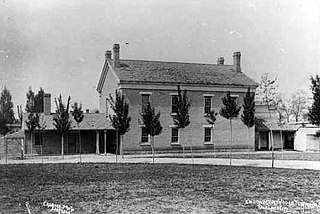
The Endowment House was an early on building used by The Church building of Jesus Christ of Latter-day Saints to administer temple ordinances in Salt Lake Metropolis, Utah Territory. From the construction of the Council Business firm in 1852, Common salt Lake City'southward first public building, until the construction of the Endowment House, the members of the LDS Church building used the top floor of the Council Firm for administering temple ordinances. When this organisation proved impractical, Brigham Immature directed Truman O. Angell, architect of the Salt Lake Temple, to design a temporary temple. Completed in 1855, the building was defended by Heber C. Kimball and came to be called the Endowment House subsequently the endowment ceremonies that were conducted inside it.
In the Latter Day Saint motility, a covenant is a hope made between God and a person or a group of people. God sets the weather condition of the covenant, and equally the weather condition are met, he blesses the person who entered into and kept the covenant. If the covenant is violated, blessings are withheld and in some cases a penalty or punishment is inflicted.

In the Latter Day Saint move, baptism is recognized as the first of several ordinances (rituals) of the gospel.

The Church building of Jesus Christ of Latter-day Saints focuses its doctrine and teaching on Jesus Christ; that he was the Son of God, born of Mary, lived a perfect life, performed miracles, bled from every pore in the Garden of Gethsemane, died on the cantankerous, rose on the third 24-hour interval, appeared once again to his disciples, and now resides, authoritatively, on the right hand side of God. In cursory, some beliefs are in mutual with Catholics, Orthodox and Protestant traditions. However, teachings of the LDS Church differ significantly in other ways and cover a broad set of doctrines, so that the above-mentioned denominations normally place the LDS Church building outside the bounds of orthodox Christian teaching as summarized in the Nicene Creed.

Baptism for the expressionless, vicarious baptism or proxy baptism today unremarkably refers to the religious practice of baptizing a person on behalf of one who is dead—a living person receiving the rite on behalf of a deceased person.

In The Church of Jesus Christ of Latter-twenty-four hour period Saints, a temple is a building defended to be a House of the Lord. Temples are considered by church members to be the almost sacred structures on earth.
In the theology of the Latter Day Saint movement, an endowment refers to a gift of "power from on high", typically associated with Latter Day Saint temples. The purpose and meaning of the endowment varied during the life of movement founder Joseph Smith. The term has referred to many such gifts of heavenly power, including the confirmation ritual, the establishment of the High Priesthood in 1831, events and rituals occurring in the Kirtland Temple in the mid-1830s, and an elaborate ritual performed in the Nauvoo Temple in the 1840s.
The following outline is provided as an overview of and a topical guide to The Church of Jesus Christ of Latter-day Saints.
Exaltation is a conventionalities amidst members of The Church of Jesus Christ of Latter-day Saints that mankind can achieve the highest level of conservancy, to eternally live in God's presence, go along as families, become gods, create worlds, and have spirit children over which they will govern. Exaltation is believed to be what God desires for all humankind. The church teaches that through exaltation believers may go joint-heirs with Jesus Christ every bit stated in Romans 8:17 and Revelation 21:seven. The objective of adherents is to strive for purity and righteousness and to become one with Jesus every bit Jesus is i with God the Father. A poetry in the canonized Doctrine and Covenants states that those who are exalted will become gods, and a 1925 statement from the church'south highest governing torso said that "All men and women are in the similitude of the universal Father and Mother ... [and are] capable, by feel through ages and aeons, of evolving into a God." A popular Mormon quote—oft attributed to the early on campaigner Lorenzo Snow in 1837—is "As man now is, God once was: As God now is, man may exist."
References
- Church Handbook of Instructions , Handbook i: Stake Presidents and Bishops, Salt Lake Metropolis, Utah: LDS Church building, 2010, pp.57 & 73
- Neuenschwander, Dennis B. (Baronial 2001), "Ordinances and Covenants", Ensign, LDS Church: 20
- Sorensen, David E. (April 1999), "Why Baptism Is Non Enough", Ensign, LDS Church: 16
- Buerger, David J. (15 December 2002). "Joseph Smith's Ritual". The Mysteries of Godliness: A History of Mormon Temple Worship. Signature Books. ISBN 978-1560851769.
- Buerger, David John (1987), "The Evolution of the Mormon Temple Endowment Ceremony", Dialogue: A Journal of Mormon Thought , 20 (iv): 33–76, archived from the original on 2011-06-13
- Buerger, David John (1983), "'The Fulness of the Priesthood': The 2d Anointing in Latter-twenty-four hour period Saint Theology and Practice" (PDF), Dialogue: A Journal of Mormon Thought , 16 (1): 12–44
- Irving, Gordon (1974), "The Law of Adoption: I Phase of the Development of the Mormon Concept of Conservancy", BYU Studies , fourteen (iii): 291–314
This page is based on this Wikipedia article
Text is available under the CC By-SA four.0 license; additional terms may apply.
Images, videos and audio are available under their respective licenses.
Source: https://WikiMili.com/en/Ordinance_%28Latter_Day_Saints%29
0 Response to "Latter Day Saint Message on Divorce and Eternal Family"
Post a Comment